
“Should I use contextual or native advertising?”
It’s one of the most common questions I see in marketing forums, Slack channels, and client meetings. And 9 times out of 10, the person asking doesn’t realize they’re comparing two completely different things.
Here’s the problem: 42% of brands are increasing their contextual advertising budgets in 2025, while native advertising spending hit $52.75 billion in the US alone. Everyone’s investing heavily in both. But most marketers can’t clearly explain the difference between them.
This confusion isn’t just semantic it’s expensive.
Companies are choosing the wrong format for their goals, measuring success with inappropriate metrics, and wondering why their results don’t match expectations.
Let’s clear this up once and for all.
What Each Actually Means (No Jargon)
The fundamental misunderstanding: marketers use these terms interchangeably. They’re not interchangeable.
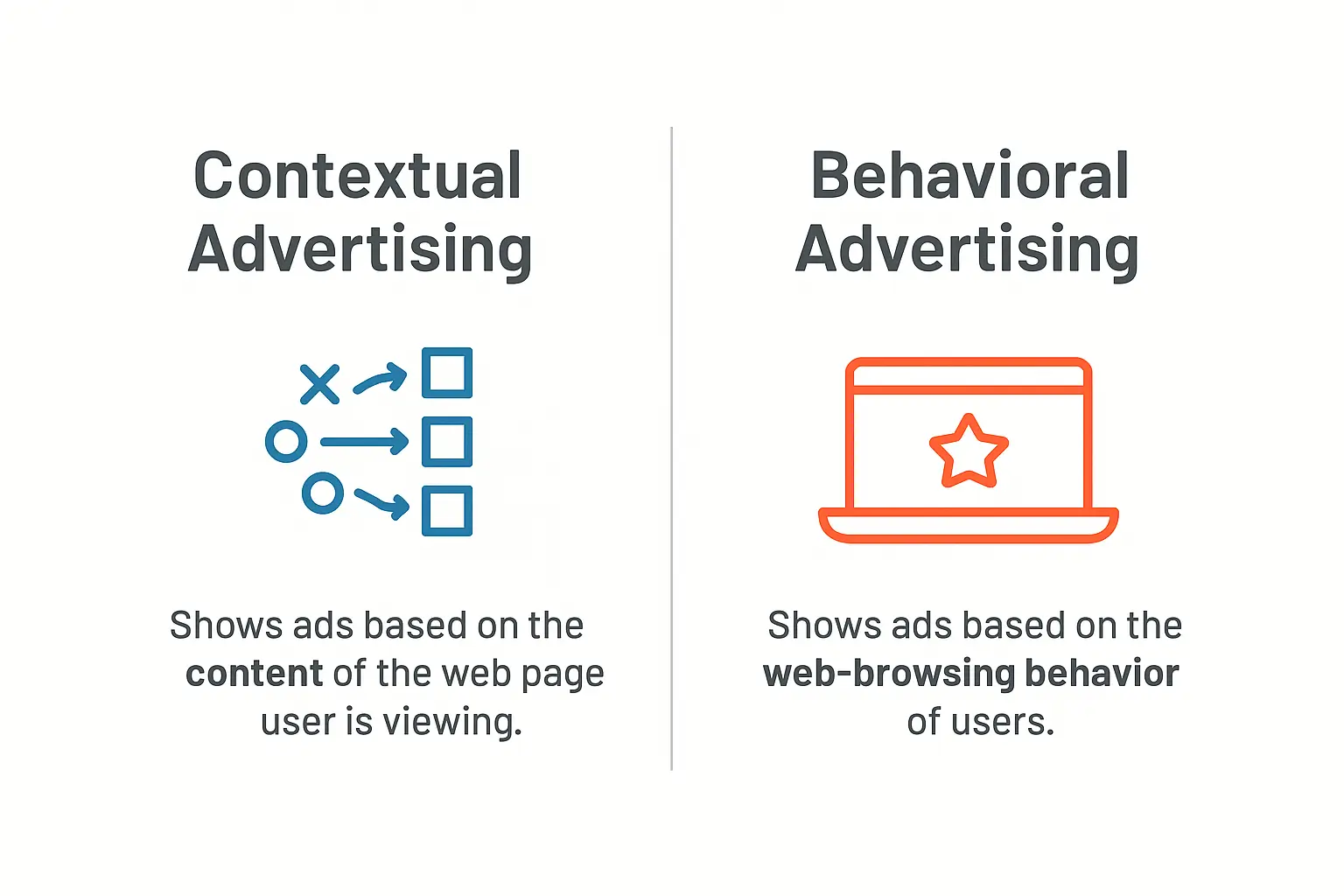
Contextual advertising is about WHERE your ad appears based on the content someone is currently viewing. The system analyzes webpage content in real-time topics, keywords, themes and serves ads that match. Reading about Python programming? Ads for coding tools. Browsing travel articles? Suitcase promotions.
Native advertising is about HOW your ad looks and integrates with the platform. It matches the form, feel, and function of the surrounding content. Native ads blend into the feed visually, appearing as a natural part of the user experience rather than an obvious advertisement.
The critical distinction: contextual is a targeting method. Native is a format.
You can have contextual ads that aren’t native. You can have native ads that aren’t contextual. And you can combine both.
Why Contextual Advertising Is Resurging in 2025
The advertising landscape is undergoing a fundamental shift driven by three converging forces:
Privacy regulations are tightening. GDPR, CCPA, and similar laws restrict how personal data can be collected and used. Browser changes are eliminating third-party cookies. The tracking infrastructure that powered behavioral advertising for years is crumbling.
Behavioral targeting accuracy was overrated. Data reveals the reality: targeting precision for women aged 18-24 was less than 20% with cookie-based methods. 66% of people targeted as parents didn’t actually have kids. Brands were paying premium CPMs to reach the wrong audiences with irrelevant messages.
Users actively resist invasive tracking. Ad blocker usage continues climbing. Consumers increasingly view behavioral tracking as creepy rather than helpful. The ads that follow you across the internet aren’t seen as convenient they’re seen as surveillance.
Contextual advertising solves all three problems simultaneously. It doesn’t require personal data, making it inherently privacy-compliant. It targets based on immediate relevance what you’re interested in right now rather than potentially outdated past behavior. And it respects user privacy while still delivering targeted messaging.
The Native Advertising Value Proposition
Native advertising emerged as a response to banner blindness and ad blocker adoption.
Traditional display ads were increasingly ignored or blocked entirely. The industry needed formats that didn’t trigger automatic user resistance.
The data shows native’s effectiveness:
53% higher ad viewability compared to traditional display advertising
Users are more likely to engage with content-style ads than obvious banners
Native formats generate better brand recall when executed properly
But native advertising comes with critical requirements. The Federal Trade Commission enforces strict disclosure guidelines. Native ads must be clearly labeled as sponsored or promoted content. The goal isn’t to deceive users into thinking ads are editorial content it’s to integrate advertising in a way that respects the user experience.
When publishers fail to properly disclose native ads, they risk regulatory action and, more importantly, user trust.Transparency isn’t optional it’s fundamental to ethical and effective native advertising.
Performance Characteristics: What the Data Shows
The question “which performs better?” misses the point. Each format excels at different objectives.
Contextual advertising strengths:
Direct response campaigns (clicks, conversions, immediate actions)
High-intent audiences actively researching solutions
Privacy-compliant targeting without personal data collection
Cost efficiency for performance-focused campaigns
Lower production costs standard ad creative works across placements
Native advertising strengths:
Brand awareness and consideration-building
Trust development over extended buyer journeys
Higher engagement rates when content provides genuine value
Better performance in the consideration phase of the funnel
Reduced ad fatigue compared to display formats
The hybrid approach: Combining both native formats with contextual targeting delivers compounding benefits. Sponsored content that matches platform design AND appears in contextually relevant environments reduces wasted impressions while maintaining user experience quality.
Research indicates campaigns using both approaches see improved performance across multiple metrics: better qualified traffic, higher conversion rates among engaged users, and stronger brand recall compared to single-format campaigns.
The Technical Stuff That Matters
Contextual advertising uses advanced algorithms to scan webpage content in real-time. AI and natural language processing analyze themes, topics, even sentiment. It’s not just keyword matching anymore though that’s still part of it.
Publishers set rules. They might use broad categories like “health” or “technology.” Or they get specific: “vegan desserts” or “luxury sedans.” The system matches your ads to appropriate content constantly.
Native advertising requires more setup. You’re essentially creating custom content for each platform. Different formats. Different specs. It’s why native ads are more expensive to produce than standard display.
But here’s what nobody tells you: setup is your filter for quality. If you’re not willing to invest in creating actually valuable native content, you probably shouldn’t be running native ads. Slapping “Sponsored” on mediocre content doesn’t make it native advertising it makes it bad advertising with a label.
The Privacy Imperative Driving Contextual Adoption
Τhe shift toward contextual advertising isn’t ideological it’s practical. The infrastructure supporting behavioral advertising is disappearing:
Third-party cookies are dying.
Chrome is phasing them out. Firefox and Safari already block them by default. The tracking mechanisms that powered user-based targeting are becoming obsolete.
Regulatory pressure intensifies. GDPR fines for privacy violations reach millions of euros. CCPA gives California consumers unprecedented control over their data. More jurisdictions are implementing similar frameworks.
Consumer preferences matter. Users increasingly choose privacy-protecting browsers and tools. Ad blocker adoption correlates with invasive tracking practices. Contextual advertising aligns with user expectations for privacy-respecting advertising.
Contextual advertising addresses these challenges by design. It analyzes content, not users. It targets based on immediate relevance rather than personal profiles. It delivers performance without requiring personal data collection or tracking across sites.
Decision Framework: Choosing the Right Approach
The choice between contextual and native advertising depends on campaign objectives, budget allocation, and where prospects are in the buyer journey.
Contextual advertising is optimal when:
Campaign goals focus on immediate conversions or actions
Target audiences are actively researching solutions (high-intent signals)
Privacy compliance is a priority or requirement
Budget constraints demand efficient spend with clear attribution
Products or services solve specific, searchable problems
Speed to market matters contextual requires less creative customization
Native advertising is optimal when:
Building brand awareness in competitive or saturated markets
Content provides genuine educational or entertainment value
Targeting prospects early in consideration phases
Budget allows for platform-specific creative development
Trust-building and brand perception matter more than immediate ROI
Long-term relationship development justifies higher initial costs
Hybrid approach (native + contextual) when:
Budget supports sophisticated multi-format campaigns
Quality content can be created that’s both valuable and contextually relevant
Metrics track both short-term performance and long-term brand health
Campaign goals include multiple funnel stages simultaneously
Resources exist for ongoing optimization across both formats
Common Strategic Errors to Avoid
Analysis of underperforming campaigns reveals recurring mistakes:
Confusing “native” with “deceptive.” Native advertising should match platform aesthetics while maintaining clear disclosure. Attempting to trick users into thinking ads are editorial content violates FTC guidelines and damages trust. Effectiveness comes from respecting user experience, not deceiving users.
Neglecting contextual relevance in native placements. High-quality native creative on poorly matched sites wastes budget. A beautifully produced sponsored article about B2B software on a lifestyle blog reaches the wrong audience regardless of format quality.
Over-reliance on single approaches. Exclusively using contextual creates predictability and potential brand-building gaps. Exclusively using native inflates costs and may miss high-intent moments. Strategic diversification based on funnel stage produces better overall results.
Misaligning metrics with format objectives. Measuring native campaigns purely on immediate conversion rates ignores their primary value: brand lift, consideration, and trust development. Conversely, judging contextual campaigns solely on brand metrics misses their direct response strength.
Underestimating mobile complexity. Creating effective native ads requires platform-specific adaptation. Mobile formats, load times, and user behavior patterns differ significantly. Native creative that works on desktop often fails on mobile without proper optimization.
What's Coming Next
The industry is heading toward hybrid models. AI is making contextual targeting increasingly sophisticated analyzing not just keywords but emotion, intent, and nuance.
Native formats are evolving too. Interactive content. Video integration. Shoppable articles. The line between content and commerce keeps blurring.
But here’s what won’t change: people want ads that are relevant without being invasive, valuable without being deceptive.
Contextual gives you relevance. Native gives you integration. Together, they give you what every marketer actually wants: attention from the right people at the right time with the right message.
Key Takeaways for Marketing Strategy
Understanding the distinction between contextual and native advertising isn’t semantic it’s strategic. Format and targeting serve different purposes and excel at different objectives.
Contextual advertising targets based on content relevance. It answers “where should this ad appear?” with “wherever the content matches our offering.” Privacy-friendly, immediately relevant, efficient for direct response.
Native advertising integrates based on visual and functional harmony. It answers “how should this ad appear?” with “in a format that respects the platform’s user experience.” Effective for trust-building, consideration development, brand awareness.
The combination of native formats with contextual targeting delivers both advantages: ads that appear in relevant environments while maintaining user experience quality.
As third-party cookies disappear and privacy regulations expand, contextual advertising will continue gaining budget share. The 42% of brands increasing contextual spending in 2025 recognize this isn’t a trend it’s the future of privacy-compliant targeting.
Native advertising will evolve toward more interactive, valuable content experiences. The $52.75 billion spent on native in the US market reflects its continued effectiveness when executed transparently and strategically.
The marketers who win will be those who understand these aren’t competing approaches they’re complementary tools. Each serves specific objectives. Both have roles in comprehensive campaign strategies. The key is matching format and targeting to goals, measuring appropriate metrics, and optimizing based on what each approach does best.
What’s your experience with contextual versus native advertising? Have you found clarity in the distinction, or does confusion persist in your organization? Share your perspective in the comments.
Your Contextual & Native Ads Are Either Printing Profit or Burning Budget. Which Is It?
If you’re still treating contextual and native as the same thing, you’re leaking money on every campaign. Get a clear, data-driven media plan that matches the right format to the right goal, fixes your metrics, and stops budget waste before the next reporting cycle.
Turn your ad mix from “let’s test and hope” into a predictable, profitable performance engine.

Afroditi Arampatzi
Marketeer
Hi, I’m Afroditi!
An experienced marketer with a passion for driving impactful projects and delivering strategic solutions.
With over 15 years of hands-on experience in project management, I specialize in advertising, data analysis, strategic planning, and team leadership.